Yet another long delay between posts.
I promise I have not stayed away from museums and the like in the interim. On the contrary, I visited the National Aquarium and Historic Ships in Baltimore and the Valley Forge National Historic Park. I also started, with the help of some friends, an Emerging Museum Professionals Group in the Philadelphia area. And I have continued my collections internship at a historic house museum, kept working at my full time job, and started a graduate certificate program in Museum Collections Management and Care through George Washington University.
Whew! All of this activity has left me with very little time to think. However, I have, over the course of several months, made some very common sense realizations about things that do not always get noticed, despite their great importance.
Each session of my current course (Collections Management: Legal and Ethical Issues) focuses, unsurprisingly, on the legal issues affecting each area of collections management. Beginning with the role of the museum as a charitable organization and the duties of trustees, the course charts the legal and ethical duties of those caring for museum collections. What I have found most striking is the heavy reliance on accurate record keeping. Every single session comes back in one way or another to the quality and content of a museum's records. A museum's defense for everything, from charges of improper care to Nazi looted art or stolen property, relies on detailed and accurate record keeping.
I am not shocked by this. After all, collections managers are charged with keeping the best, most complete and most accurate records possible. In practice, however, the records for many museum objects are incomplete, missing or incorrect. Previous generations of museum staff simply did not keep records of the same type or quality now required by professional standards. Smaller organizations with untrained and unpaid staff may be ignorant of these standards in the first place.
Having had no formal instruction in this area, I had never fully realized the legal (not to mention ethical) ramifications of these deficiencies. The organization for which I am interning has no records of any kind. We are currently completing the very first inventory of the museum's collection. No accession paperwork exists. Many of the objects have no provenance whatsoever. Worse, the institution has no collection management policy establishing policies and procedures for record keeping.
The staff at the museum will soon start working on a comprehensive collection management policy. As we move forward with the policy and the (nearly complete) inventory, complete and accurate record keeping will play a central role in the process. Standards for creating and maintaining good record keeping will need to be established. I am appreciative of the timely reminder of the central importance of good record keeping and grateful for the opportunity to see the process enacted from start to finish.
27 October 2011

31 August 2011
Listen to the Music
As much as I do not want to spend the rest of my career in Visitor Services, I do often get to do really interesting things. Yesterday I accompanied a group of musicians called the Sixth Floor Trio through the museum while they performed "random acts of culture,." They set up in a gallery and then played a song.
The music had a definite impact on those who heard it. Empty galleries would soon become crowded when the music started. And when they played in the Great Stair Hall, people gathered along the balcony to listen. A few clapped when the music ended.
I love the idea of a roving band of musicians playing the galleries. They had the ability to choose galleries that fit songs in their repertoire. With any luck, the memory of the music will help to reinforce the visitor's memory of their experience at the museum. And, hopefully, the music improved their overall experience and they will soon return.
The music had a definite impact on those who heard it. Empty galleries would soon become crowded when the music started. And when they played in the Great Stair Hall, people gathered along the balcony to listen. A few clapped when the music ended.
I love the idea of a roving band of musicians playing the galleries. They had the ability to choose galleries that fit songs in their repertoire. With any luck, the memory of the music will help to reinforce the visitor's memory of their experience at the museum. And, hopefully, the music improved their overall experience and they will soon return.
02 August 2011
Narrow Stairs
I read this post today on the Center for the Future of Museums blog and had to share.
Please take the stairs! The Philadelphia Museum of Art has plenty of stairs, even apart from the ones that Rocky conquered. Not only does taking the stairs have a health benefit but it also provides a view of the museums lobbies that the elevators simply do not provide. Even better, when you take the stairs from the ground floor to the first floor you get the best possible viewing of Marc Chagall's A Wheatfield on a Summer Afternoon. Whether you like Chagall or not (I, personally, do not, but I do love this particular painting) this size of this painting and the brightness of the colors will take your breath away.
So give the stairs a shot. You may be surprised by what you see.
Please take the stairs! The Philadelphia Museum of Art has plenty of stairs, even apart from the ones that Rocky conquered. Not only does taking the stairs have a health benefit but it also provides a view of the museums lobbies that the elevators simply do not provide. Even better, when you take the stairs from the ground floor to the first floor you get the best possible viewing of Marc Chagall's A Wheatfield on a Summer Afternoon. Whether you like Chagall or not (I, personally, do not, but I do love this particular painting) this size of this painting and the brightness of the colors will take your breath away.
So give the stairs a shot. You may be surprised by what you see.
28 July 2011
Walking with a Ghost
I attended a fantastic lecture and discussion at Eastern State Penitentiary earlier this week.
The lecture and subsequent discussion focused on the site's dependence on its haunted house, Terror Behind the Walls, which takes place from September through Halloween each year. Terror Behind the Walls has been extremely popular and brought in a full 65% of ESP's operating budget in 2010. ESP staff believe that Terror Behind the Walls allows them to operate the increasingly popular daytime, history-based tours of the site and also to make much-needed improvements to the site such as a temporary roof over one of the cell blocks. Although nearly the same number of people attended the daytime tours as did Terror Behind the Walls last year, it does seem that one supports the other. People in the audience attested to this fact.
This state of affairs, however, saddens me. I love ESP and have visited several times. The staff does an excellent job of interpreting the site and are improving the connections made between ESP and the current prison situation in this country. They care very deeply about presenting an honest and accurate look at the prison's history. I wish that the organization could sustain itself without such heavy reliance on the funds brought in through Terror Behind the Walls.
One final thought. I am very conflicted about Terror Behind the Walls. On the one hand, this event supports ESP throughout the year and ESP's staff has used the funds well. But on the other hand, Terror Behind the Walls could serve to reinforce negative stereotypes about prisons, prisoners and prison guards. ESP is stuck firmly between a rock and a hard place.
I am reminded of a story about the Philadelphia History Museum published in the New York Times last December. The museum sold some pieces from its collection in order to finance renovations and the improvement of its storage facilities, etc.
ESP and the Philadelphia History Museum seem to have raised money in the best way and attempted to use the resulting funds in the most productive and ethical way possible. But have they lost something in the process?
The lecture and subsequent discussion focused on the site's dependence on its haunted house, Terror Behind the Walls, which takes place from September through Halloween each year. Terror Behind the Walls has been extremely popular and brought in a full 65% of ESP's operating budget in 2010. ESP staff believe that Terror Behind the Walls allows them to operate the increasingly popular daytime, history-based tours of the site and also to make much-needed improvements to the site such as a temporary roof over one of the cell blocks. Although nearly the same number of people attended the daytime tours as did Terror Behind the Walls last year, it does seem that one supports the other. People in the audience attested to this fact.
This state of affairs, however, saddens me. I love ESP and have visited several times. The staff does an excellent job of interpreting the site and are improving the connections made between ESP and the current prison situation in this country. They care very deeply about presenting an honest and accurate look at the prison's history. I wish that the organization could sustain itself without such heavy reliance on the funds brought in through Terror Behind the Walls.
One final thought. I am very conflicted about Terror Behind the Walls. On the one hand, this event supports ESP throughout the year and ESP's staff has used the funds well. But on the other hand, Terror Behind the Walls could serve to reinforce negative stereotypes about prisons, prisoners and prison guards. ESP is stuck firmly between a rock and a hard place.
I am reminded of a story about the Philadelphia History Museum published in the New York Times last December. The museum sold some pieces from its collection in order to finance renovations and the improvement of its storage facilities, etc.
ESP and the Philadelphia History Museum seem to have raised money in the best way and attempted to use the resulting funds in the most productive and ethical way possible. But have they lost something in the process?
16 July 2011
Better Together, Part 2
Once again, I love that the various parts of my life sometimes intersect in amazing and helpful ways.
Last week I managed to take a long stroll through the American art galleries while at work. I am ashamed to admit how infrequently I am able to visit the gallery spaces in my own museum. Because I had not visited the American art wing for such a long time, I had forgotten just how many pieces of furniture the museum owns. Not only are the pieces beautiful in their own right, but they also helped me with the collections inventory work I mentioned in an earlier post. Based on what I saw, I was able to confirm some of the identifications and date ranges I had placed on the objects with which I was working. Receiving confirmation of one's suspicions about an object can be uplifting and I will admit that I enjoyed the boost to my self esteem.
I often wonder if other museum employees neglect to visit their own museum's gallery spaces. I find myself putting the visits of for tomorrow because the galleries aren't going anywhere anytime soon. Perhaps I will make it my goal for the second half of 2011 to spend more time inside the galleries. The stuff inside them is, after all, what made me want to work in museums in the first place.
Last week I managed to take a long stroll through the American art galleries while at work. I am ashamed to admit how infrequently I am able to visit the gallery spaces in my own museum. Because I had not visited the American art wing for such a long time, I had forgotten just how many pieces of furniture the museum owns. Not only are the pieces beautiful in their own right, but they also helped me with the collections inventory work I mentioned in an earlier post. Based on what I saw, I was able to confirm some of the identifications and date ranges I had placed on the objects with which I was working. Receiving confirmation of one's suspicions about an object can be uplifting and I will admit that I enjoyed the boost to my self esteem.
I often wonder if other museum employees neglect to visit their own museum's gallery spaces. I find myself putting the visits of for tomorrow because the galleries aren't going anywhere anytime soon. Perhaps I will make it my goal for the second half of 2011 to spend more time inside the galleries. The stuff inside them is, after all, what made me want to work in museums in the first place.
04 July 2011
Wild Gardens
Yesterday my parents and I visited Longwood Gardens for the first time since my childhood. I love these sorts of "horticultural museums." I really enjoy beautiful, outdoor floral displays for the same reasons that I love paintings--they please me aesthetically. For example, take a long look at these photos:


Those individuals in charge of maintaining Longwood Gardens do amazing work. The gardens possess breathtaking beauty and we spent a very pleasant day wandering through the various sections of the grounds.
I believe, however, that the gardens miss a couple of great opportunities for historical interpretation. Perhaps the most glaring is the Peirce-du Pont House, a historic house originally built on the property in 1730. The house contains an exhibition detailing the history of the gardens and of their original owner, Pierre du Pont. The garden's story certainly needs to be told but I would have loved to have also learned about the house. A structure built so long ago deserves to be interpreted in its own right, rather than simply serving as the setting for a generic history of the gardens.
But I cannot criticize without also giving credit where it is due. Longwood Gardens has no shortage of fascinating signage, in addition to the beautiful plants and flowers. My favorite signs pointed out the various forms of Integrated Pest Management practiced by the gardens. For example, in the lily pad section of the conservatory, a small fish has been introduced to the pools of water to help contain mosquitos and other insects. The collections manager in me finds these tidbits extremely interesting. Plus, the lily pads have a beauty unlike that of most other plants.

Plan a visit to Longwood Gardens, especially if you have not visited for many years. I loved resurrecting memories of an earlier trip which I had long since forgotten.


Those individuals in charge of maintaining Longwood Gardens do amazing work. The gardens possess breathtaking beauty and we spent a very pleasant day wandering through the various sections of the grounds.
I believe, however, that the gardens miss a couple of great opportunities for historical interpretation. Perhaps the most glaring is the Peirce-du Pont House, a historic house originally built on the property in 1730. The house contains an exhibition detailing the history of the gardens and of their original owner, Pierre du Pont. The garden's story certainly needs to be told but I would have loved to have also learned about the house. A structure built so long ago deserves to be interpreted in its own right, rather than simply serving as the setting for a generic history of the gardens.
But I cannot criticize without also giving credit where it is due. Longwood Gardens has no shortage of fascinating signage, in addition to the beautiful plants and flowers. My favorite signs pointed out the various forms of Integrated Pest Management practiced by the gardens. For example, in the lily pad section of the conservatory, a small fish has been introduced to the pools of water to help contain mosquitos and other insects. The collections manager in me finds these tidbits extremely interesting. Plus, the lily pads have a beauty unlike that of most other plants.

Plan a visit to Longwood Gardens, especially if you have not visited for many years. I loved resurrecting memories of an earlier trip which I had long since forgotten.
03 July 2011
Better Together
I love when the various areas of my life intersect in unexpected and exciting ways.
First, a note on my prolonged absence from the blog. Following a health issue that took me out of commission for several weeks, I started an internship at a local historic house. I spend my days off cataloging all sorts of furniture, glass and paintings in an attempt to complete the first-ever inventory of this particular organization's collections. The emphasis in this project has been on getting the basics down on paper: a description of the object; its dimensions; and its location within the house. More in-depth analysis and research will be done later, once the full inventory has been completed.
This relatively new area of my life collided with my "real life" last weekend on a visit to Pittsburgh. I, along with my boyfriend and best friend, visited the Heinz History Center (which you should definitely check out on your next stop in the Steel City).

We strolled through a fascinating exhibition entitled Shattering Notions, which described in detail the importance of glass manufacture to the Pittsburgh region. As I studied some of the objects in the exhibition I realized that I had seen them before--when I cataloged them.
I nearly squealed with delight in the middle of the exhibition. The historic house at which I am interning has no curatorial files whatsoever. We know next to nothing about the objects in the collection or from where they may have come. And, as previously mentioned, our focus is entirely on other areas at the moment. I was naturally excited to be able to match an object to a label on a wall and take back a few valuable pieces of information. We can now correctly date several objects, as well as accurately report their manufacturer, which will eventually lead to new avenues of research.
This episode, for me at least, represents more than a strange coincidence on a weekend away or the ability to fill in gaps of knowledge for a wonderful historic house. My encounter with a piece of Pittsburgh pressed glass reminded me of something that I love about objects--they can connect us to another time and place. Just like hearing your favorite song from fifteen years ago can transport you back to the first time you heard it, seeing an object that used to belong to a grandparent can make you relive the moments you spent with them.
As museums reconsider the role that objects should play, we need to remind ourselves of the power that objects can have when used and interpreted effectively. As Stephen Conn states in his book Do Museums Still Need Objects?, objects lose relevance when "the objects cease to provide coherence to the ideas behind their collection and display, when the ideas themselves fail to coalesce into a coherent body of knowledge, and when other institutions position themselves better as producers and providers of information." When used as complements to fantastic ideas objects can help an visitor relate to an exhibition on a much deeper and more personal level than label text. Sometimes we just need a piece of pressed glass to remind us.
First, a note on my prolonged absence from the blog. Following a health issue that took me out of commission for several weeks, I started an internship at a local historic house. I spend my days off cataloging all sorts of furniture, glass and paintings in an attempt to complete the first-ever inventory of this particular organization's collections. The emphasis in this project has been on getting the basics down on paper: a description of the object; its dimensions; and its location within the house. More in-depth analysis and research will be done later, once the full inventory has been completed.
This relatively new area of my life collided with my "real life" last weekend on a visit to Pittsburgh. I, along with my boyfriend and best friend, visited the Heinz History Center (which you should definitely check out on your next stop in the Steel City).

We strolled through a fascinating exhibition entitled Shattering Notions, which described in detail the importance of glass manufacture to the Pittsburgh region. As I studied some of the objects in the exhibition I realized that I had seen them before--when I cataloged them.
I nearly squealed with delight in the middle of the exhibition. The historic house at which I am interning has no curatorial files whatsoever. We know next to nothing about the objects in the collection or from where they may have come. And, as previously mentioned, our focus is entirely on other areas at the moment. I was naturally excited to be able to match an object to a label on a wall and take back a few valuable pieces of information. We can now correctly date several objects, as well as accurately report their manufacturer, which will eventually lead to new avenues of research.
This episode, for me at least, represents more than a strange coincidence on a weekend away or the ability to fill in gaps of knowledge for a wonderful historic house. My encounter with a piece of Pittsburgh pressed glass reminded me of something that I love about objects--they can connect us to another time and place. Just like hearing your favorite song from fifteen years ago can transport you back to the first time you heard it, seeing an object that used to belong to a grandparent can make you relive the moments you spent with them.
As museums reconsider the role that objects should play, we need to remind ourselves of the power that objects can have when used and interpreted effectively. As Stephen Conn states in his book Do Museums Still Need Objects?, objects lose relevance when "the objects cease to provide coherence to the ideas behind their collection and display, when the ideas themselves fail to coalesce into a coherent body of knowledge, and when other institutions position themselves better as producers and providers of information." When used as complements to fantastic ideas objects can help an visitor relate to an exhibition on a much deeper and more personal level than label text. Sometimes we just need a piece of pressed glass to remind us.
23 February 2011
Ring Them Bells
About a week and a half ago my boyfriend and I visited what are probably Philadelphia's best-known historic sites: Independence Hall and the Liberty Bell. Since I have lived in Philadelphia for almost a year, and because fewer numbers of tourists would be around during the cold, winter months, we figured the time had come for a visit to these iconic sites. Not surprisingly, I have some thoughts to share about each.
Matt and I both agreed on a favorite between the two sites. Although I cannot speak for his opinions, I believe we both felt more connected to the Independence Hall than to the Liberty Bell. The building itself is beautiful. I particularly enjoyed the gorgeous woodwork. Although I cannot do justice to the building, here are some photos:


I had the sense of being somewhere important, in a location where something absolutely vital had occurred. Because I have previous knowledge of the process by which the Founding Fathers put together the U.S. Constitution, I found myself imagining what it must have been like. The image of the men locked in a room, roasting in the heat of a Philadelphia summer, became real to me in a way it previously had not been.
Unfortunately, the weakest part of our experience at Independence Hall was the guided tour led by an individual from the Park Service. The content of the tour was jumbled and did not present a nuanced version of the building's history. Matt and I both agreed that individuals without prior knowledge of American history would likely come away having learned very little.
The Liberty Bell Museum provided the opposite experience. I enjoyed the exhibits at the museum highlighting the history and importance of the Liberty Bell. Although the signage contained copious amounts of text I never felt overwhelmed or bored. The information provided a nuanced and fairly complete history of the Liberty Bell.
However, when it came time to stand in front of the Liberty Bell, this supposedly iconic piece of American history, I felt underwhelmed. I felt more attached to the Bell as a symbol of other things than as an object.
That said, the Bell has been perfectly situated in a circular glass room looking out at Independence Hall. I found the setting pretty enough to enhance my otherwise unremarkable experience of the Bell.


I am in no way saying that one should opt out of a visit to either Independence Hall or the Liberty Bell Museum. Please go! I would, however, recommend visiting during the winter so that you avoid the crowds of people that swarm over Independence Mall during the summer months. I would also suggest tempering your expectations. Not everyone will feel a deep connection to these sites, despite their cultural and historical significance.
Matt and I both agreed on a favorite between the two sites. Although I cannot speak for his opinions, I believe we both felt more connected to the Independence Hall than to the Liberty Bell. The building itself is beautiful. I particularly enjoyed the gorgeous woodwork. Although I cannot do justice to the building, here are some photos:


I had the sense of being somewhere important, in a location where something absolutely vital had occurred. Because I have previous knowledge of the process by which the Founding Fathers put together the U.S. Constitution, I found myself imagining what it must have been like. The image of the men locked in a room, roasting in the heat of a Philadelphia summer, became real to me in a way it previously had not been.
Unfortunately, the weakest part of our experience at Independence Hall was the guided tour led by an individual from the Park Service. The content of the tour was jumbled and did not present a nuanced version of the building's history. Matt and I both agreed that individuals without prior knowledge of American history would likely come away having learned very little.
The Liberty Bell Museum provided the opposite experience. I enjoyed the exhibits at the museum highlighting the history and importance of the Liberty Bell. Although the signage contained copious amounts of text I never felt overwhelmed or bored. The information provided a nuanced and fairly complete history of the Liberty Bell.
However, when it came time to stand in front of the Liberty Bell, this supposedly iconic piece of American history, I felt underwhelmed. I felt more attached to the Bell as a symbol of other things than as an object.
That said, the Bell has been perfectly situated in a circular glass room looking out at Independence Hall. I found the setting pretty enough to enhance my otherwise unremarkable experience of the Bell.


I am in no way saying that one should opt out of a visit to either Independence Hall or the Liberty Bell Museum. Please go! I would, however, recommend visiting during the winter so that you avoid the crowds of people that swarm over Independence Mall during the summer months. I would also suggest tempering your expectations. Not everyone will feel a deep connection to these sites, despite their cultural and historical significance.
29 December 2010
Identity Crisis
Another post? So soon?
Yes! I came across this article in the NY Times about identity museums. The examples cited by Mr. Rothstein are instructive and I found his argument interesting.
I should add that I found the article only because of the great people at Global Museum, who send a fantastic e-mail once a week with lots of museum tidbits. They also have a very helpful job board. Check it out!
Yes! I came across this article in the NY Times about identity museums. The examples cited by Mr. Rothstein are instructive and I found his argument interesting.
I should add that I found the article only because of the great people at Global Museum, who send a fantastic e-mail once a week with lots of museum tidbits. They also have a very helpful job board. Check it out!
27 December 2010
With Tired Eyes, Tired Minds, Tired Souls, We Slept
You may have noticed that I have slacked off a bit lately, especially when it comes to commenting on museums. The reason? I have not visited any museums or historic sites for quite a while.
Why, you ask? I have been pondering the same question. I have certainly not yet exhausted the list of possible sites. Philadelphia and the surrounding communities have many museums and historic sites that I have not yet visited. In fact, there are probably more than I even know about.
The reasons for my recent failures are several. The first reason is one shared by many individuals and it is financial. Sometimes visiting museums and historic sites is expensive. Between transportation, parking and admission costs, a visit can sometimes cost more money than I feel I can spare. But many historic sites in Philadelphia are very inexpensive, or even free. So why the absence of any visits?
I am ashamed to say it but lately I have just not been in the mood to visit museums. I spend most of my time in a very large museum smiling at people and letting them know where they can find the bathrooms. I often visit new exhibitions and walk through the galleries. Sometimes the last thing I want to do on my day off is visit another museum. Reading even more label text feels oppressive. My initial enthusiasm about being in a new city has worn off and I do not feel the same pressure to make the trip to Center City on a day when I do not have to do so for work. Combine this feeling with the craziness of the holiday season, with all of the extra shopping trips and time spent wrapping gifts and I just do not have the time.
Shameful, I know.
So I offer my New Year’s Resolution to you. I will strive to visit the sites I have been putting off and to rekindle my interest in other institutions. Wish me luck.
Why, you ask? I have been pondering the same question. I have certainly not yet exhausted the list of possible sites. Philadelphia and the surrounding communities have many museums and historic sites that I have not yet visited. In fact, there are probably more than I even know about.
The reasons for my recent failures are several. The first reason is one shared by many individuals and it is financial. Sometimes visiting museums and historic sites is expensive. Between transportation, parking and admission costs, a visit can sometimes cost more money than I feel I can spare. But many historic sites in Philadelphia are very inexpensive, or even free. So why the absence of any visits?
I am ashamed to say it but lately I have just not been in the mood to visit museums. I spend most of my time in a very large museum smiling at people and letting them know where they can find the bathrooms. I often visit new exhibitions and walk through the galleries. Sometimes the last thing I want to do on my day off is visit another museum. Reading even more label text feels oppressive. My initial enthusiasm about being in a new city has worn off and I do not feel the same pressure to make the trip to Center City on a day when I do not have to do so for work. Combine this feeling with the craziness of the holiday season, with all of the extra shopping trips and time spent wrapping gifts and I just do not have the time.
Shameful, I know.
So I offer my New Year’s Resolution to you. I will strive to visit the sites I have been putting off and to rekindle my interest in other institutions. Wish me luck.
09 December 2010
To Deaccession or Not to Deaccession?
According to this piece published in the New York Times earlier this week, the Philadelphia History Museum has been selling pieces from its collection to finance the first major renovations to the building since the 1940's.
The museum desperately needed to weed out some pieces from its collection. It did not have the space or the budget to care for a collection of that size. The building also needed to be renovated and updated. (Nancy Moses hints at the difficulties faced by the museum in her book Lost in the Museum: Buried Treasures and the Stories They Tell.) The museum would need to raise incredibly large sums of money in order to complete these upgrades.
I sympathize with the museum's argument that the money obtained from the sale of various historic objects goes entirely toward ensuring the preservation and safety of what remains in the collection, but the whole process leaves a sour taste in my mouth. This situation is different from other institutions making news recently for deaccessioning objects to pay for daily operating costs. I also recognize that the intentions of the museum's staff are very good. They are attempting to do what is best for the museum and its collection. But did no other options for raising money exist?
According to the "News" section on the museum's website, the museum has received various grants and other sources of funding. I find it hard to believe that these sources, as well as individual donors, were tapped before resorting to auctioning off parts of the collection to the highest bidder.
I fear that deaccessioning has become, for many museums, an easy way to fund projects that might otherwise be hard too expensive or difficult to finance rather than a means of acquiring better or more representative pieces for the collection. Deaccessioning should not be the means by which a museum funds its daily operations or its renovations.
The museum desperately needed to weed out some pieces from its collection. It did not have the space or the budget to care for a collection of that size. The building also needed to be renovated and updated. (Nancy Moses hints at the difficulties faced by the museum in her book Lost in the Museum: Buried Treasures and the Stories They Tell.) The museum would need to raise incredibly large sums of money in order to complete these upgrades.
I sympathize with the museum's argument that the money obtained from the sale of various historic objects goes entirely toward ensuring the preservation and safety of what remains in the collection, but the whole process leaves a sour taste in my mouth. This situation is different from other institutions making news recently for deaccessioning objects to pay for daily operating costs. I also recognize that the intentions of the museum's staff are very good. They are attempting to do what is best for the museum and its collection. But did no other options for raising money exist?
According to the "News" section on the museum's website, the museum has received various grants and other sources of funding. I find it hard to believe that these sources, as well as individual donors, were tapped before resorting to auctioning off parts of the collection to the highest bidder.
I fear that deaccessioning has become, for many museums, an easy way to fund projects that might otherwise be hard too expensive or difficult to finance rather than a means of acquiring better or more representative pieces for the collection. Deaccessioning should not be the means by which a museum funds its daily operations or its renovations.
05 October 2010
Patience and Grace
For anyone who doesn't already know, I work in Visitor Services, which effectively means that I wear many different hats. I help out in the Development Office once a week, occasionally work in the operator's booth and man the museum's various coatrooms, in addition to selling tickets and answering general museum questions. Today I happened to be doing two of these jobs simultaneously. As I kept watch over a few coats, bags and umbrellas in the coatroom I stuffed envelops and applied mailing labels to two different mailings for the Development Office.
Mid-stuff a momentarily horrifying thought crossed my mind: this is not why I went to graduate school.
In a very real sense, I did not go to graduate school to stuff envelops, hang up coats or sell tickets. Inquiring visitors have asked me what my "real job" is after learning about my background. I have felt embarrassed, even ashamed, of my job at various points.
But when I really think about the job that I do, I start to feel a little better. The work I do is humbling - in a good way. And I can see the connections between what I do now and what I want to do. Yes, I would prefer to be working with the collections in a hands-on kind of way but showing people how to find them in a gallery is in many ways just as important. The mission of any museum is, after all, to educate as well as to preserve.
Even if I didn't specifically get a degree in envelop-stuffing or label-applying, I did go to school to work in a museum. Right now, I am extremely grateful for the opportunity and I will await a collections position with both patience and grace.
Mid-stuff a momentarily horrifying thought crossed my mind: this is not why I went to graduate school.
In a very real sense, I did not go to graduate school to stuff envelops, hang up coats or sell tickets. Inquiring visitors have asked me what my "real job" is after learning about my background. I have felt embarrassed, even ashamed, of my job at various points.
But when I really think about the job that I do, I start to feel a little better. The work I do is humbling - in a good way. And I can see the connections between what I do now and what I want to do. Yes, I would prefer to be working with the collections in a hands-on kind of way but showing people how to find them in a gallery is in many ways just as important. The mission of any museum is, after all, to educate as well as to preserve.
Even if I didn't specifically get a degree in envelop-stuffing or label-applying, I did go to school to work in a museum. Right now, I am extremely grateful for the opportunity and I will await a collections position with both patience and grace.
18 September 2010
Speed Read
Last weekend I visited Zoo America in Hershey, PA with my boyfriend, Matt. While the "wildlife park" is relatively small (about 11 acres), we had a great time. The signage was informative and the many directional signs made our map practically unnecessary. I revisited my childhood by feeding the ducks and had the opportunity to see some animals of which I had never heard. Here is a small sampling of what we saw:

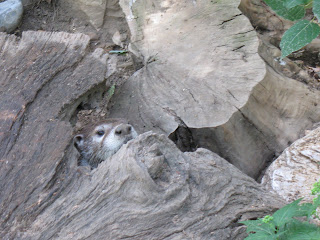
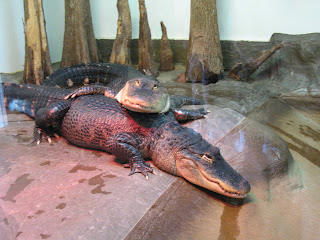
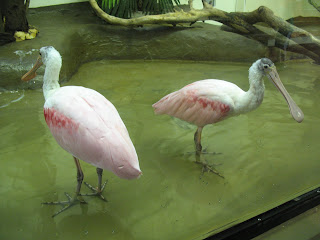
As we ambled through the various exhibits I was struck by two things. First, Zoo America reminded me of the close link, often overlooked, between museums and zoos/aquariums. Museums and zoos have similar missions: they seek to educate the public and to preserve their "collections." People often forget this fact, but it has potentially powerful implications. Whenever various experts talk about the state of museums in the United States today, they rarely include zoos in their analysis. Imagine if they did. We should also consider whether or not zoos and museums should work together more closely when attempting to secure funding and when lobbying the government for support.
Second, our visit to Zoo America reminded me once again of the importance of proofreading. I could bring up this point in relation to almost every museum, zoo or historic site I visit. I implore those in charge of creating signage to check and double-check what you have written! Don't let this happen to you:

Also, if you like animals, check out The Animal Review. The blog is amusing, informative and a complete delight. Enjoy!


As we ambled through the various exhibits I was struck by two things. First, Zoo America reminded me of the close link, often overlooked, between museums and zoos/aquariums. Museums and zoos have similar missions: they seek to educate the public and to preserve their "collections." People often forget this fact, but it has potentially powerful implications. Whenever various experts talk about the state of museums in the United States today, they rarely include zoos in their analysis. Imagine if they did. We should also consider whether or not zoos and museums should work together more closely when attempting to secure funding and when lobbying the government for support.
Second, our visit to Zoo America reminded me once again of the importance of proofreading. I could bring up this point in relation to almost every museum, zoo or historic site I visit. I implore those in charge of creating signage to check and double-check what you have written! Don't let this happen to you:

Also, if you like animals, check out The Animal Review. The blog is amusing, informative and a complete delight. Enjoy!
16 August 2010
The View from this Tower
I want to encourage everyone to do a something if at all possible: take a behind-the-scenes tour of your favorite museum.
I had the opportunity to take such a tour today at the Philadelphia Museum of Art. As anyone who has been to the museum knows, the building is not only incredible, it is also historic. Parts of the building that were open to the public many years ago have now been converted to other uses and are hidden from the layman's eyes. These parts of the building are beautiful and it was fascinating to see them and to hear them talked about by someone who clearly loves the building and knows more about it than I could ever hope to.
The best part of the tour, however, was being on the roof.
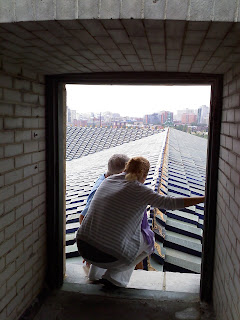
To be honest, I had been to the PMA's subbasements before. I knew that they had as much beauty as the rest of the building. But to see the view from the roof was to understand the building in an entirely new way. The view from the top of the building impressed on me not only the sheer size of the building, but also its height.
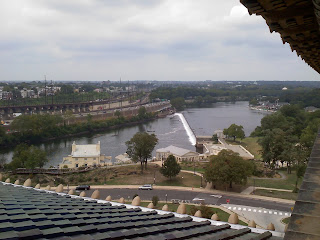
In short, find a way to take a behind-the-scenes tour of your favorite museum. Having seen the storage areas and hidden nooks and crannies of several museums and historic sites I can assure you that the most interesting stuff is the stuff most people never get the chance to see. I would also like to encourage museum staff to try to find a way to allow more people to see their museum from this unique vantage point. Don't limit this experience to staff and those with sufficient disposable income to purchase high level memberships. After all, you never know who you may inspire.
*My apologies for the less-than-stellar quality of the photos; rather than using a real camera I used the only thing at hand, which happened to be my cell phone.
I had the opportunity to take such a tour today at the Philadelphia Museum of Art. As anyone who has been to the museum knows, the building is not only incredible, it is also historic. Parts of the building that were open to the public many years ago have now been converted to other uses and are hidden from the layman's eyes. These parts of the building are beautiful and it was fascinating to see them and to hear them talked about by someone who clearly loves the building and knows more about it than I could ever hope to.
The best part of the tour, however, was being on the roof.

To be honest, I had been to the PMA's subbasements before. I knew that they had as much beauty as the rest of the building. But to see the view from the roof was to understand the building in an entirely new way. The view from the top of the building impressed on me not only the sheer size of the building, but also its height.

In short, find a way to take a behind-the-scenes tour of your favorite museum. Having seen the storage areas and hidden nooks and crannies of several museums and historic sites I can assure you that the most interesting stuff is the stuff most people never get the chance to see. I would also like to encourage museum staff to try to find a way to allow more people to see their museum from this unique vantage point. Don't limit this experience to staff and those with sufficient disposable income to purchase high level memberships. After all, you never know who you may inspire.
*My apologies for the less-than-stellar quality of the photos; rather than using a real camera I used the only thing at hand, which happened to be my cell phone.
01 August 2010
Your Time Has Come
Lately I have been wondering if I will ever make it out of the world of visitor services and into collections management, the area of museum work for which I trained and in which I find the most enjoyment. Trying to find one of these positions is time consuming, frustrating and seemingly endlessly disappointing.
I was therefore thrilled to be handed a copy of Nina Simon's short article called "Doing Time on the Front Line" published in the July-August 2010 issue of Museum. (You can find a copy of the article here) It is so reassuring to hear someone say what I already think to be true - that working in the museum's front lines beneficial is not only beneficial, it can also lead to other opportunities in the future.
Selfishly, I hope that my time on the front lines at the Philadelphia Museum of Art will prove to be beneficial in terms of future employment opportunities. But I also hope that this article can inspire in others what it has inspired in me: hope.
I was therefore thrilled to be handed a copy of Nina Simon's short article called "Doing Time on the Front Line" published in the July-August 2010 issue of Museum. (You can find a copy of the article here) It is so reassuring to hear someone say what I already think to be true - that working in the museum's front lines beneficial is not only beneficial, it can also lead to other opportunities in the future.
Selfishly, I hope that my time on the front lines at the Philadelphia Museum of Art will prove to be beneficial in terms of future employment opportunities. But I also hope that this article can inspire in others what it has inspired in me: hope.
18 July 2010
Ramblin' Man
After two crazy days of tramping all over Philadelphia with my parents, I have some comments to make.
First up: the Eastern State Penitentiary
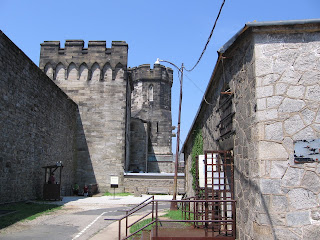
Let me preface this by saying that I was completely skeptical about this place before visiting. The prison's website is something just less than good and I was afraid it would rely too heavily on its reputation as a haunted historic building. I decided to visit the penitentiary more as a means of entertaining my parents than anything else.
I now wish to retract my previous assumptions. The audio guide (included in your ticket price) gives a good history of the building. There are about nine introductory audio stops, and then you can wander around the rest of the grounds as you choose. Most of the "optional" audio tour stops have labels giving at least minimal background information, meaning that one could choose to continue without the audio guide. The audio guides are thus flexible and affordable. Plus, Eastern State is unique. Although Philly has plenty of historic buildings and museums, to my knowledge there is nothing quite like Eastern State anywhere else in the city.
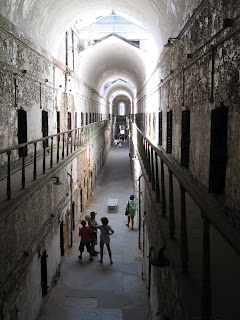
The penitentiary is also close to some other great cultural institutions, including the Philadelphia Museum of Art and any of the other BF Parkway Museums. The Fairmount neighborhood also has some great dining options. I recommend Figs, located at the corner of 25th and Meredith Streets.
Next up: the U.S. Mint

The Mint is one of those government buildings that just makes me sigh. The exhibits are shabby. The glue holding some of the exhibits together is beginning to fail and its obvious that the exhibits have not had an overhaul in years. That said, the tour is free, somewhat informative, and I did learn how coins are made. Plus, everyone likes to see the coin-making process live from the gallery windows above the factory. My final assessment: don't snub the Mint, just don't expect bells, whistles, or anything fancy.
Last but not least: the Wanamaker Organ at Macy's
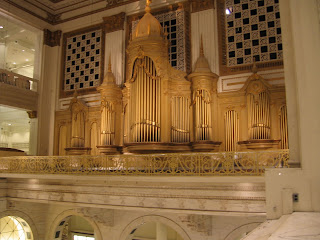
I have to give my mother the credit for tracking down this little gem. The organ is included on one of the walking tour cards I mentioned a few weeks ago. In 1874, the Wanamaker Department Store moved to what is now the Macy's building at S. 13th and Market Streets. John Wanamaker installed the world's largest pipe organ in the store's seven-floor Grand Court. The organ is still played two times each day.
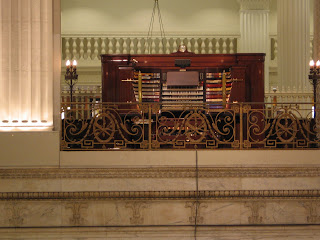
First of all, the building is worth visiting even if you could care less about the organ. Its an absolutely beautiful building that is still used for its original purpose. Second, the organ itself its gorgeous and its size is simply overwhelming. It is difficult to comprehend just how impressive the instrument is without actually going to see it. Third, you get to hear a really great organist play the organ for free in an amazing setting. The experience is entirely worthwhile, and even more so since it won't cost you a cent. Unless, of course, you can't help yourself from shopping while you're there.
First up: the Eastern State Penitentiary

Let me preface this by saying that I was completely skeptical about this place before visiting. The prison's website is something just less than good and I was afraid it would rely too heavily on its reputation as a haunted historic building. I decided to visit the penitentiary more as a means of entertaining my parents than anything else.
I now wish to retract my previous assumptions. The audio guide (included in your ticket price) gives a good history of the building. There are about nine introductory audio stops, and then you can wander around the rest of the grounds as you choose. Most of the "optional" audio tour stops have labels giving at least minimal background information, meaning that one could choose to continue without the audio guide. The audio guides are thus flexible and affordable. Plus, Eastern State is unique. Although Philly has plenty of historic buildings and museums, to my knowledge there is nothing quite like Eastern State anywhere else in the city.

The penitentiary is also close to some other great cultural institutions, including the Philadelphia Museum of Art and any of the other BF Parkway Museums. The Fairmount neighborhood also has some great dining options. I recommend Figs, located at the corner of 25th and Meredith Streets.
Next up: the U.S. Mint

The Mint is one of those government buildings that just makes me sigh. The exhibits are shabby. The glue holding some of the exhibits together is beginning to fail and its obvious that the exhibits have not had an overhaul in years. That said, the tour is free, somewhat informative, and I did learn how coins are made. Plus, everyone likes to see the coin-making process live from the gallery windows above the factory. My final assessment: don't snub the Mint, just don't expect bells, whistles, or anything fancy.
Last but not least: the Wanamaker Organ at Macy's

I have to give my mother the credit for tracking down this little gem. The organ is included on one of the walking tour cards I mentioned a few weeks ago. In 1874, the Wanamaker Department Store moved to what is now the Macy's building at S. 13th and Market Streets. John Wanamaker installed the world's largest pipe organ in the store's seven-floor Grand Court. The organ is still played two times each day.

First of all, the building is worth visiting even if you could care less about the organ. Its an absolutely beautiful building that is still used for its original purpose. Second, the organ itself its gorgeous and its size is simply overwhelming. It is difficult to comprehend just how impressive the instrument is without actually going to see it. Third, you get to hear a really great organist play the organ for free in an amazing setting. The experience is entirely worthwhile, and even more so since it won't cost you a cent. Unless, of course, you can't help yourself from shopping while you're there.
13 July 2010
Time Will Crawl
A time capsule recently discovered in nearby Atlantic City, NJ got me thinking about the burial and discovery of these little gems. What makes time capsules so amazing, you ask?
1. Typically, "normal" people bury time capsules and dream about their future discovery. These capsules are not left behind by movie stars or CEO's. Instead, John and Jane Smith in Nowhereville prepare and hide items they believe might be interesting or useful in the future.
2. To imagine who buried the time capsule is amazing. What were the people like? What did they do? Who did they envision finding and opening their time capsule?
3. A time capsule is a study in what makes the history of objects (rather than art) so fascinating and important. Time capsules not only come from very ordinary people; they show us what ordinary people found worth sharing. We can investigate why each object was chosen and what it means.
Thanks, as always, to Matt for passing this article along. Here are a few more to whet your appetite:
North Platte, NB Time Capsule
YouTube Time Capsule
Pierre, SD Time Capsule
1. Typically, "normal" people bury time capsules and dream about their future discovery. These capsules are not left behind by movie stars or CEO's. Instead, John and Jane Smith in Nowhereville prepare and hide items they believe might be interesting or useful in the future.
2. To imagine who buried the time capsule is amazing. What were the people like? What did they do? Who did they envision finding and opening their time capsule?
3. A time capsule is a study in what makes the history of objects (rather than art) so fascinating and important. Time capsules not only come from very ordinary people; they show us what ordinary people found worth sharing. We can investigate why each object was chosen and what it means.
Thanks, as always, to Matt for passing this article along. Here are a few more to whet your appetite:
North Platte, NB Time Capsule
YouTube Time Capsule
Pierre, SD Time Capsule
29 June 2010
Final Answer
My memory is terrible.
I want to recommend a fantastic podcast from the BBC called "A History of the World in 100 Objects." Anyone who agrees that historic objects are central to an understanding of ourselves and our past can't help but enjoy the podcast.
Look for the podcast through iTunes or on the BBC's website.
I want to recommend a fantastic podcast from the BBC called "A History of the World in 100 Objects." Anyone who agrees that historic objects are central to an understanding of ourselves and our past can't help but enjoy the podcast.
Look for the podcast through iTunes or on the BBC's website.
Money Honey
My source of all interesting news stories passed this very unfortunate one to me this evening. It seems that financial problems have forced the State Museum of Pennsylvania to cut hours and raise admission prices.
This story is heartbreaking. A lack of state funding forced the museum to begin charging admission fees last summer, and the situation has only gotten worse in the meantime. Pennsylvania Governor Ed Rendell has continued to slash state funding to museums, to the point that the Pennsylvania Historic and Museum Commission barely has any staff left. I strongly support appropriately funding cultural institutions of all kinds so that everyone can afford to visit.
It is a travesty that the state of Pennsylvania cannot do any better than this.
This story is heartbreaking. A lack of state funding forced the museum to begin charging admission fees last summer, and the situation has only gotten worse in the meantime. Pennsylvania Governor Ed Rendell has continued to slash state funding to museums, to the point that the Pennsylvania Historic and Museum Commission barely has any staff left. I strongly support appropriately funding cultural institutions of all kinds so that everyone can afford to visit.
It is a travesty that the state of Pennsylvania cannot do any better than this.
23 June 2010
Quite Free
I want to praise the Philadelphia Museum of Art (my employer, in case you have forgotten) for providing a day last week free of charge. The museum waived the cost of general admission last Saturday in honor of the museum's late director Anne d'Harnoncourt. I love these kinds of days because they make museum collections accessible to large portions of the population who may not normally be able to afford a trip to a high-quality art museum. Days with free general admission help a museum to accomplish one of its most important goals: educating the public about its collection.
But nothing can be that simple.
Without fail, free admission days mean that museum staff will spend much of their time asking visitors not to eat or drink in the galleries, to turn off their camera flashes, and not to touch the art work. Children will run and scream. Parents will yell. Everyone will talk too loudly. Generally speaking, the people who come to museums on days with free admission spend very, very little time inside museums. The visitors lack knowledge about museum conduct.
Let me be quite clear: I do not fault these people for being unaware of proper museum protocol. Many people just do not know how to behave in museums. The reasons for this are complex and not easy to pin down. Many children attend a museum of some kind while in their elementary years, and should, in theory, learn how to act at museums on these trips. However, these trips are probably too infrequent and brief to make much of an impression. I would also argue that the dynamic of school trips is different than on a regular trip to the museum. The students often eat in a separate location and are provided with stimulating activities. This kind of stimulation is likely to occur on a weekend visit with their parents or older siblings.
Part of the problem may also be that museums tend to be minimalists when it comes to signage. They fail in many cases to make people aware of the rules upon entering the museum. In my mind, listing the rules on the back of the museum map in small print simply doesn't cut it.
I'm quite sure that I'm missing a host of other reasons for people's bad behavior, but I want to make some observations about potential fixes for this issue. The first is obvious: make museum attendance a more common theme in every child's formative years. Make sure that these trips extend beyond the elementary years and well into middle school and high school. I am not talking about more trips for kids whose parents are likely to take them to art museums anyway. I'm talking about the kids whose parents have probably never been to a museum since their own school years.
Museums should also not feel shy about posting the rules in a more obvious way on days when the building will be flooded with visitors coming more for free entertainment than for the museum itself. A couple of well-placed signs will certainly intrude less upon a person's experience at the museum than screaming children and irritable security guards. (For some great journalism about the importance and necessity of good signage, read this series of articles by Slate's Julia Turner.)
In the end, museum etiquette is no different than etiquette at the symphony, the opera, or a church service. The way people behave in any public situation comes down to knowledge. If people are not aware that a code of conduct exists, how can we expect them to follow it?
In the name of spreading the word, here are a couple of good references for proper museum behavior.
http://www.artagogo.com/reviews/learn1/learn5.htm
http://www.associatedcontent.com/article/397360/museum_etiquette_how_to_behave_when.html?cat=2
But nothing can be that simple.
Without fail, free admission days mean that museum staff will spend much of their time asking visitors not to eat or drink in the galleries, to turn off their camera flashes, and not to touch the art work. Children will run and scream. Parents will yell. Everyone will talk too loudly. Generally speaking, the people who come to museums on days with free admission spend very, very little time inside museums. The visitors lack knowledge about museum conduct.
Let me be quite clear: I do not fault these people for being unaware of proper museum protocol. Many people just do not know how to behave in museums. The reasons for this are complex and not easy to pin down. Many children attend a museum of some kind while in their elementary years, and should, in theory, learn how to act at museums on these trips. However, these trips are probably too infrequent and brief to make much of an impression. I would also argue that the dynamic of school trips is different than on a regular trip to the museum. The students often eat in a separate location and are provided with stimulating activities. This kind of stimulation is likely to occur on a weekend visit with their parents or older siblings.
Part of the problem may also be that museums tend to be minimalists when it comes to signage. They fail in many cases to make people aware of the rules upon entering the museum. In my mind, listing the rules on the back of the museum map in small print simply doesn't cut it.
I'm quite sure that I'm missing a host of other reasons for people's bad behavior, but I want to make some observations about potential fixes for this issue. The first is obvious: make museum attendance a more common theme in every child's formative years. Make sure that these trips extend beyond the elementary years and well into middle school and high school. I am not talking about more trips for kids whose parents are likely to take them to art museums anyway. I'm talking about the kids whose parents have probably never been to a museum since their own school years.
Museums should also not feel shy about posting the rules in a more obvious way on days when the building will be flooded with visitors coming more for free entertainment than for the museum itself. A couple of well-placed signs will certainly intrude less upon a person's experience at the museum than screaming children and irritable security guards. (For some great journalism about the importance and necessity of good signage, read this series of articles by Slate's Julia Turner.)
In the end, museum etiquette is no different than etiquette at the symphony, the opera, or a church service. The way people behave in any public situation comes down to knowledge. If people are not aware that a code of conduct exists, how can we expect them to follow it?
In the name of spreading the word, here are a couple of good references for proper museum behavior.
http://www.artagogo.com/reviews/learn1/learn5.htm
http://www.associatedcontent.com/article/397360/museum_etiquette_how_to_behave_when.html?cat=2
Subscribe to:
Posts (Atom)